
Order a bowl of udon in Tokyo and then in Osaka, and you might think the kitchen made a mistake. In Tokyo the soup is dark brown, almost the colour of soy sauce itself. In Osaka it is a pale, clear gold — so light that visitors sometimes wonder if it will taste of anything at all.
Same noodles, same dish, two completely different philosophies. The difference is the dashi — the stock that forms the base of almost all Japanese cooking — and the soy sauce used to season it.
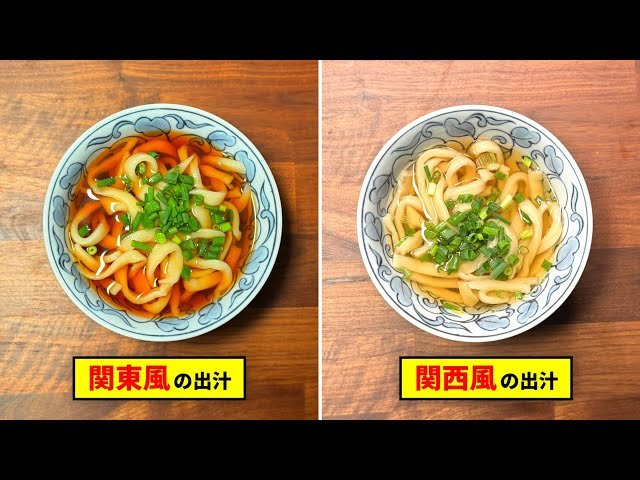
Kanto style: the aroma of bonito
In eastern Japan (Kanto, around Tokyo), dashi for udon is built on katsuo — dried bonito flakes — which give a strong, smoky aroma. It is seasoned generously with koikuchi, the dark, rich soy sauce most people outside Japan know simply as “soy sauce”. The result is a bold, salty, dark broth that stands up for itself. The colour is part of the point: it looks as strong as it tastes.
Kansai style: the umami of kombu
In western Japan (Kansai, around Osaka and Kyoto), the base is kombu — kelp — which gives a quieter, rounder umami. Osaka was historically Japan’s great trading city for kombu, which arrived by ship from Hokkaido, so the city’s kitchens learned to build flavour on it.
Just as important is the seasoning: usukuchi, a light-coloured soy sauce. Despite its pale colour, usukuchi is actually slightly saltier than koikuchi — it is used in small amounts to season the broth without darkening it, so the golden colour of the dashi itself, and the colours of the ingredients, stay visible. That visual clarity comes from Kyoto’s refined kaiseki tradition, and Osaka adopted it wholeheartedly.
So the pale broth is not a weak broth. It is a deliberate choice: flavour from the dashi, not from the seasoning.
How to taste the difference
Udon is the easiest way to compare, because the noodles are plain and the broth is the whole show. If you are staying in Osaka, order a simple kitsune udon — sweet fried tofu in hot broth. Kitsune udon is said to have been invented in Osaka in the 1890s, and in a good local shop the broth will be that clear Kansai gold, with the kombu umami arriving gently and the bonito just behind it.
A few tips:
- Don’t judge by colour. Pale means the chef is confident in the dashi.
- Drink the broth. In Kansai, finishing the soup is a compliment.
- If you also travel to Tokyo on the same trip, order the same dish there. The contrast is striking — dark and punchy in the east, pale and layered in the west.
The shopping streets around Tsuruhashi and Uehonmachi, near our Saikudani houses, are full of small udon shops where you can try the Kansai style for a few hundred yen, standing at the counter like a local.
FAQ
Is Kansai udon broth weaker than Kanto’s?
No. It looks paler because it is seasoned with light-coloured usukuchi soy sauce, but the flavour comes from kombu dashi and is deep in umami. Usukuchi is actually slightly saltier than the dark soy sauce used in Kanto.
Why is Osaka’s broth based on kombu?
Osaka was the hub of the historical kombu trade from Hokkaido, and its food culture — influenced by Kyoto’s kaiseki cuisine — values clear colours and dashi-driven flavour.
Where can I try Kansai-style udon in Osaka?
Almost any local udon shop in Osaka serves the pale Kansai style. The shopping streets around Tsuruhashi, Uehonmachi and Imazato, near our houses, have plenty of small shops.
Food is one of the best ways to understand how Osaka differs from Tokyo — and it starts with a bowl of udon. Stay with us and taste it where it was born:

コメント